Penetrant Line (DPI / FPI Inspection Systems)
Online Catalog ↗ Not sure this is the right one? Find it in 3 questions →NEXSEN penetrant immersion tanks are designed and manufactured using a custom engineering approach based on specific customer requirements and application needs. During the design phase, parameters such as part geometry, dimensions, production volume, penetrant inspection method (visible or fluorescent), and process workflow are carefully evaluated to determine the most suitable penetrant processing system.
NEXSEN penetrant immersion tanks are used as part of the penetrant testing process to perform penetrant application, emulsification, rinsing, developing, and drying operations in a controlled and repeatable manner. These tanks ensure consistent penetrant coverage and reliable inspection results by providing stable process conditions throughout the inspection cycle.
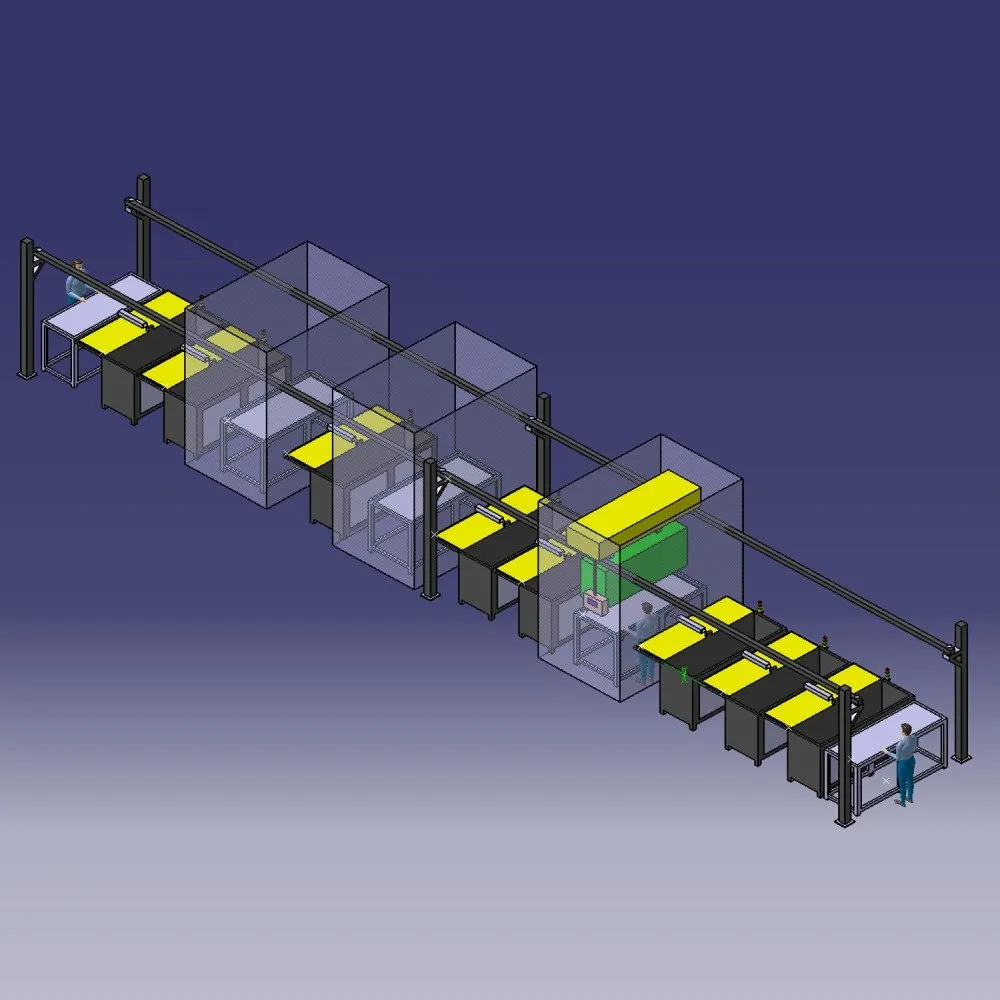
The systems can be configured as individual tanks or as part of a complete penetrant inspection line, depending on production requirements. NEXSEN penetrant immersion systems can be designed for manual, semi-automatic, or fully automatic operation.
A typical penetrant immersion system may include the following process stations:
-
Penetrant application tank
-
Emulsifier tank (lipophilic or hydrophilic)
-
Water rinse tank
-
Drying oven
-
Developer application system (dry powder or wet developer)
-
Final drying station
Tank Design Features
NEXSEN penetrant immersion tanks are manufactured using industrial-grade materials resistant to penetrant chemicals and cleaning agents, ensuring durability and long-term operation in demanding industrial environments.
Standard design features may include:
-
Chemical-resistant stainless steel tank construction
-
Overflow and filtration systems
-
Temperature control systems
-
Chemical level monitoring systems
-
Agitation systems for penetrant uniformity
-
Drainage and maintenance access points
-
Adjustable part baskets or fixtures
-
Integrated lifting systems or hoists for heavy components
Process Control Parameters
To ensure consistent penetrant inspection results, the following technical parameters are considered during system design:
-
Penetrant dwell time
-
Penetrant sensitivity level (Level 1 / Level 2 / Level 3)
-
Emulsification time and concentration
-
Rinse water pressure and flow rate
-
Drying temperature control
-
Developer application uniformity
-
Chemical contamination monitoring
Typical Penetrant Process Flow
A typical penetrant inspection process may include the following stages:
-
Pre-cleaning
-
Penetrant immersion (Level 1 / Level 2 / Level 3 penetrant)
-
Penetrant dwell time
-
Excess penetrant removal
-
Emulsifier application (lipophilic or hydrophilic)
-
Water rinse
-
Drying
-
Developer application (dry powder or wet developer)
-
Final drying (if required)
-
Inspection under UV-A or white light
Applicable Standards
NEXSEN penetrant immersion tank systems can be designed in accordance with the following international standards:
-
ISO 3452 – Non-destructive testing — Penetrant testing
-
ASTM E165 / E165M – Liquid Penetrant Examination
-
ASTM E1417 / E1417M – Liquid Penetrant Testing
-
ASME Boiler and Pressure Vessel Code Section V – Article 6
-
AMS 2644 – Penetrant inspection materials
-
ISO 3059 – Lighting requirements for NDT
Applications
NEXSEN penetrant immersion tank systems are used to detect surface-breaking defects such as cracks, porosity, seams, laps, and other surface discontinuities in industries including:
-
Aerospace and defense
-
Automotive manufacturing
-
Casting and forging industries
-
Railway systems
-
Oil and gas equipment manufacturing
-
General industrial manufacturing
Click the link below for our article on What is the Penetrant Testing:
What is the Penetrant Testing?
Click the link below for our article on Penetrant Sensitivity Levels:
Penetrant Sensitivity Levels
Penetrant Sensitivity Levels
Click the link below for our Penetrant Cabinet products:
Penetrant Cabinet
Penetrant Cabinet
For videoscope inspection of materials such as shafts and couplings after penetrant testing, the following product may be of interest to you:
Shaft and Coupling Inspection System
Shaft and Coupling Inspection System
Related products
Which equipment is right for you?Pick what you need to do:
Find surface cracks / surface defectsFind internal defects (voids, inclusions, weld flaws)Measure wall thickness or corrosionMeasure hardnessIdentify or sort materials (alloy, hardness)See or measure inside pipes, engines, turbinesInspect steel wire ropesClean parts (ultrasonic cleaning)Find calibration or reference blocks
Start the Product Finder →CONTACT
Tell us about your inspection needs — we will choose the right solution together.
Cumhuriyet Mah. Demokrasi Cad. No: 60/B
Çekmeköy / İstanbul +90 216 235 15 31 info@nexsen.com.tr Message us on WhatsApp →
Çekmeköy / İstanbul +90 216 235 15 31 info@nexsen.com.tr Message us on WhatsApp →