
The Importance of Surface Hardness Testing in Industry
Surface hardness value is one of the most critical parameters determining material quality in manufacturing, quality assurance, and field applications. Applying the correct hardness test method to the right material prevents inaccurate results and avoids component damage.
With advancing technology, portable hardness testers offering rapid on-site analysis have become indispensable alongside laboratory benchtop instruments. So, which hardness tester is best suited for your application? Should you choose the Leeb hardness method or Ultrasonic (UCI) hardness testing technology?
At NEXSEN, as the contracted official distributor of the German manufacturer BAQ, we break down the most common portable hardness testing methods in light of innovative engineering.
1. What is the Ultrasonic (UCI) Hardness Testing Method?
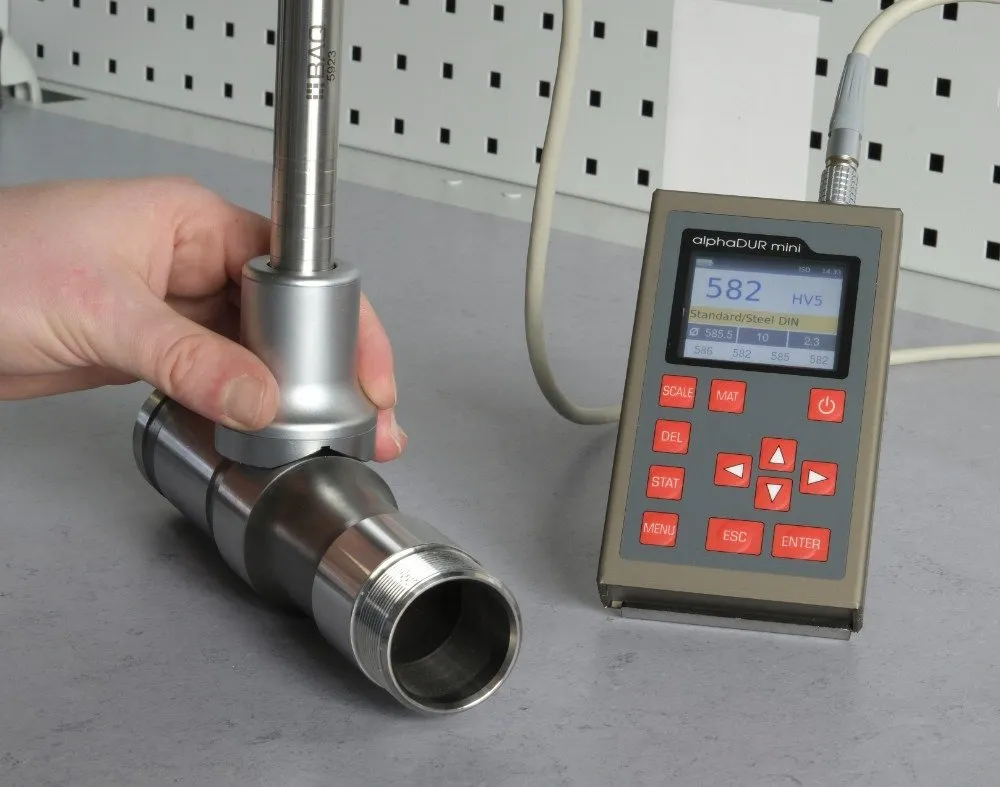
The UCI (Ultrasonic Contact Impedance) method relies on pressing a Vickers diamond indenter attached to a vibrating rod into the material surface. As the indenter penetrates the surface, the vibration frequency changes, which the device instantly converts into a precise hardness reading.
Advantages of the UCI Method:
-
Non-Destructive Testing (NDT): Leaves a microscopic indentation virtually invisible to the naked eye.
-
No Component Mass Limitation: Delivers accurate results on thin-walled parts, sheet metals, tubes, and lightweight components without requiring backing mass.
-
Heat Treatment & Coating Inspection: Ideal for induction-hardened surfaces, nitrided layers, and weld Heat-Affected Zones (HAZ).
Featured Instruments: BAQ AlphaDur Mini and the touchscreen BAQ AlphaDur 3 models deliver lab-grade UCI hardness analysis on the shop floor.
2. What is the Leeb (Rebound) Hardness Testing Method?
The Leeb hardness method relies on propelling an impact body via spring mechanism onto the material surface and calculating hardness from the ratio of its rebound velocity to impact velocity.
Advantages of the Leeb Method:
-
Ideal for Heavy & Massive Components: The most practical method for foundries, forging plants, and heavy steel structures.
-
Large Surface Area Coverage: Allows rapid scanning across large blocks with higher surface roughness.
-
Versatile Impact Devices: Compatible with various impact devices like D, DC, DL, C, and G for narrow channels, internal pipe walls, and heavy castings.
Featured Instruments: BAQ dynaROCK III and BAQ PocketDur deliver high speed and repeatability for massive cast and forged components.
3. A Hybrid Solution Combining Both Methods: BAQ alphaROCK
If your facility handles both delicate heat-treated components and heavy casting blocks, a combined system eliminates the need for two separate devices. The BAQ alphaROCK automatically recognizes connected UCI and Leeb probes, allowing seamless operation across both testing methods in a single instrument.
4. Specialized Methods for Soft Metals and Composites: Webster & Barcol
For materials other than steel and cast iron (such as aluminum profiles, stainless sheet metals, FRP/GRP composites, or rigid plastics), specialized portable testing methods are preferred over traditional Leeb or UCI techniques:
-
Webster Hardness Testers: Pincer-style design allows quick, one-handed testing for aluminum extrusion profiles, tubes, and sheets (ASTM B647).
-
Barcol Impressor (Analog & Digital): Provides single-sided indentation hardness testing for aluminum castings, fiber-reinforced composite panels, and rigid plastics (ASTM B648 / ASTM D2583).
Conclusion: Guarantee Your Quality with NEXSEN
Determining the ideal hardness tester for your process depends on component geometry, wall thickness, mass, and surface roughness. German-engineered BAQ hardness testers offer a comprehensive product range to meet every industrial testing challenge.
As the authorized distributor of BAQ, NEXSEN’s expert technical team is ready to assist you with on-site product demonstrations, sales, and post-sales technical support in full accordance with manufacturer standards.
Explore Our BAQ Products and Categories
Visit our categories to find the ideal hardness testing solution for your shop floor or laboratory, download detailed technical documentation, and explore our product lineup:
Related Product Categories:
Portable Hardness Testers: (Our complete lineup of mobile testing solutions)
Ultrasonic (UCI) Hardness Testers (For thin-walled, heat-treated, and delicate parts)
Rebound (Leeb) Hardness Testers (For heavy castings, forgings, and massive steel structures)

Webster Pincer Hardness Testers (For aluminum extrusions, pipes, and sheet metals)
Barcol Hardness Testers (For FRP/GRP composites, aluminum, and rigid plastics)
Featured BAQ Hardness Testers:
BAQ AlphaDur Mini III & AlphaDur 3: Non-destructive Ultrasonic (UCI) hardness testing solutions.

BAQ dynaROCK III: Universal Leeb hardness tester with auto probe recognition and color screen.
BAQ alphaROCK: Hybrid hardness tester uniting UCI and Leeb methods in a single casing.
BAQ Webster & Barcol Impressor: Practical field testing solutions for aluminum, extrusions, sheet metals, and composites.
Request a Demo & Technical Support from NEXSEN
As the contracted distributor of BAQ, NEXSEN is here to help you select the right model for your application. Contact our technical sales team today to learn more, schedule an on-site demonstration, or request a quote!
info@nexsen.com.tr
+90 216 235 15 31