
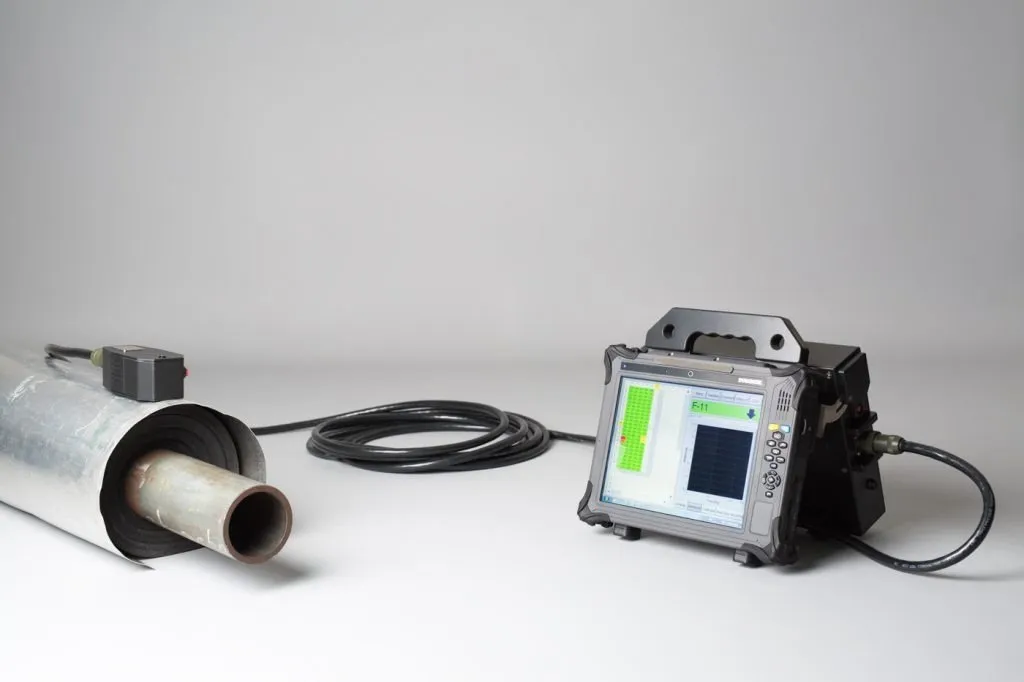
Pulsed Eddy Current Testing: Corrosion Mapping Through Insulation Without Removing Cladding
Corrosion hidden beneath insulation is one of the most difficult integrity problems to manage in refineries, petrochemical plants, power-generation facilities and offshore installations.
Conventional inspection methods often require insulation and protective cladding to be removed before the steel surface can be examined. This process can be expensive, time-consuming and disruptive. It may also expose the insulation system to damage and create additional reinstatement work after the inspection.
Pulsed Eddy Current Testing, commonly known as PECT or PEC, provides an alternative approach. The technology allows inspectors to screen carbon steel equipment through insulation and protective cladding, helping identify areas of general wall-thickness loss without exposing the complete steel surface.
When combined with a position encoder and structured inspection grid, Pulsed Eddy Current data can also be used for corrosion mapping through insulation.
What Is Pulsed Eddy Current Testing?
Pulsed Eddy Current Testing is an electromagnetic non-destructive testing method used to assess the average remaining thickness of ferromagnetic steel.
During an inspection, the PECT probe generates a controlled magnetic pulse. This magnetic field passes through the materials between the probe and the steel surface and induces eddy currents within the steel.
After the pulse is switched off, the eddy currents gradually decay. The instrument records and analyses this decay response to estimate the average steel thickness within the measurement area, known as the probe footprint.
Unlike conventional ultrasonic thickness measurement, PECT does not require:
- Direct contact with the steel surface
- Removal of the complete insulation system
- Surface grinding or extensive surface preparation
- Liquid couplant between the probe and the component
This makes the method particularly useful for screening insulated carbon steel assets.
What Is Corrosion Under Insulation?
Corrosion Under Insulation, or CUI, is corrosion that develops on the external surface of insulated equipment.
Water can enter an insulation system through damaged weather barriers, cladding joints, penetrations, supports or poorly sealed areas. Once moisture reaches the steel surface, it can remain trapped beneath the insulation and create conditions that promote corrosion.
Because the damage is hidden, the external cladding may appear to be in acceptable condition while significant metal loss develops underneath.
Common assets affected by CUI include:
- Insulated process pipework
- Pressure vessels
- Storage tanks
- Columns
- Heat-exchanger connections
- Offshore piping systems
- Carbon steel equipment with fireproofing
- Equipment exposed to cyclic operating temperatures
Finding CUI can be challenging because removing insulation from every area is rarely practical. A screening technique is therefore required to help determine where targeted insulation removal and detailed follow-up inspection should be performed.
How Does PECT Detect Corrosion Through Insulation?
PECT does not directly create an image of the corrosion surface. Instead, it measures changes in the average remaining steel thickness within the probe footprint.
Before an inspection, reference measurements are normally taken in an area where the original or expected wall thickness is known. Measurements collected across the inspection area are then compared with the reference condition.
A reduction in the calculated average wall thickness may indicate:
- General corrosion
- Distributed metal loss
- Wall thinning beneath insulation
- A change in material thickness
- An area requiring further investigation
PECT is therefore best understood as a screening and prioritisation method.
It helps inspection teams distinguish between areas with relatively uniform thickness and locations where significant changes may be present.
Corrosion Mapping Through Insulation
Individual PECT measurements can be collected at defined inspection locations. When these readings are arranged in a structured grid, the resulting data can be presented as a colour-coded corrosion or wall-thickness map.
An optional single-axis position encoder can connect measurement data to the probe position. The encoder can be attached to the standard PECT probes and supports systematic data acquisition along the inspected component.
The MAXWELL PECT system supports several data-collection methods:
Point-by-Point Measurement
The operator positions the probe at a defined location and manually triggers each measurement.
This approach is useful where:
- Access is limited
- The component geometry is complex
- Only selected locations need to be inspected
- A predefined inspection grid is used
Dynamic Scanning
Measurements are triggered by the position encoder while the probe moves along the inspection surface.
Dynamic scanning can increase inspection speed under favourable conditions where:
- Probe movement is stable
- The surface is sufficiently even
- Vibration is limited
- Reliable positional tracking is possible
Stop-and-Go Scanning
In Stop-and-Go mode, a measurement is triggered when the encoder detects that the probe has stopped moving.
This approach combines structured positional recording with improved measurement stability and can be useful in less favourable field conditions.
The collected data can be colour coded and exported to Microsoft Excel for evaluation and reporting.
What Does a PECT Corrosion Map Show?
A PECT corrosion map represents changes in the calculated average wall thickness across the inspected area.
Depending on the inspection procedure and reporting format, the map may show:
- Relative wall-thickness changes
- Calculated remaining average thickness
- Percentage wall loss
- Areas with consistent readings
- Areas with significant deviation from the reference
- Locations recommended for follow-up inspection
It is important to understand that every PECT reading represents an average value over a physical area.
The diameter of this measurement footprint is approximately 1.5 times the insulation thickness, with a minimum footprint diameter of approximately 25 mm. As the insulation thickness increases, the measurement area becomes larger.
For this reason, PECT is highly effective for detecting general or distributed corrosion but may not individually resolve very small, isolated pits.
PECT Measurement Range and Lift-Off
The distance between the probe and the steel surface is commonly referred to as lift-off.
For the MAXWELL PECT U11, the maximum lift-off depends on the steel wall thickness:
| Steel wall thickness | Maximum lift-off |
|---|---|
| Up to 15 mm | 250 mm |
| More than 15 mm up to 30 mm | 200 mm |
| More than 30 mm up to 65 mm | 100 mm |
The instrument is designed for steel wall thicknesses between approximately 2 mm and 65 mm.
The stated 250 mm maximum lift-off should not be interpreted as applying to every inspection. The achievable distance depends on wall thickness, component geometry, cladding material and actual field conditions.
Which Materials Can PECT Inspect Through?
The magnetic field used by PECT can pass through many materials positioned between the probe and the carbon steel surface.
Typical examples may include:
- Thermal insulation
- Paint systems
- Protective coatings
- Corrosion products
- Aluminium cladding
- Stainless steel insulation sheeting
- Non-magnetic materials
- Water
- Bitumen
- Concrete in suitable applications
Aluminium and stainless steel insulation sheeting are identified as suitable cladding materials in the MAXWELL PECT U11 technical documentation.
Galvanised sheeting requires additional consideration because it may be magnetic. Performance through galvanised or other magnetic cladding depends on the material properties and should be verified during inspection setup.
Typical PECT Measurement Accuracy
PECT measures the average steel thickness within the probe footprint.
For the MAXWELL PECT U11, the typical stated accuracy is approximately:
±10% of the average steel thickness
The result is influenced by factors such as:
- Reference quality
- Steel wall thickness
- Lift-off distance
- Insulation configuration
- Component geometry
- Surface condition
- Cladding material
- Probe positioning
- Equipment vibration
- Inspection procedure
Because the measurement is averaged over the footprint, a small deep pit may have less influence on the result than widespread corrosion across the same area.
Critical or suspicious PECT indications should therefore be evaluated using an appropriate follow-up method.
PECT Compared with Ultrasonic Thickness Testing
Pulsed Eddy Current Testing and Ultrasonic Thickness Testing serve different purposes and are often complementary.
| Pulsed Eddy Current Testing | Ultrasonic Thickness Testing |
|---|---|
| Can screen through insulation | Usually requires access to the steel surface |
| Measures average thickness over a footprint | Produces a local thickness measurement |
| Suitable for rapid area screening | Suitable for detailed local measurement |
| No liquid couplant required | Normally requires couplant |
| Helps prioritise insulation removal | Helps confirm and size local wall loss |
| Effective for general corrosion | More suitable for precise local thickness checks |
PECT should not be presented as a complete replacement for ultrasonic inspection.
A practical CUI inspection strategy may use PECT to screen a large insulated area, followed by local insulation removal and ultrasonic testing at selected locations.
Main Advantages of Corrosion Mapping Through Insulation
Reduced Insulation Removal
PECT can reduce the number of locations where insulation must be removed solely for initial corrosion screening.
Faster Inspection of Large Areas
Structured point measurements or encoder-assisted scanning allow larger areas to be assessed more efficiently.
Lower Reinstatement Costs
Reducing unnecessary cladding and insulation removal can lower replacement materials, labour and scaffolding requirements.
Improved Inspection Prioritisation
Colour-coded mapping helps integrity teams identify areas that require further examination.
No Liquid Couplant
PECT does not require the coupling liquid used in conventional ultrasonic measurements.
Repeatable Monitoring
Inspection grids and position-referenced measurements can support comparisons during future inspection campaigns, provided consistent procedures and reference conditions are maintained.
Support for Risk-Based Inspection
PECT results can help provide additional condition information for inspection planning and asset-integrity decision-making.
Limitations of Pulsed Eddy Current Testing
Every NDT method has limitations, and PECT should be applied by trained personnel using an approved inspection procedure.
Important considerations include:
- PECT is primarily intended for ferromagnetic steel.
- Results represent average thickness over the probe footprint.
- Very small isolated pits may not be individually resolved.
- Measurement sensitivity changes with increasing lift-off.
- Thick steel reduces the maximum achievable lift-off.
- Magnetic cladding can affect performance.
- Nearby steel components, supports or geometry changes may influence readings.
- A reliable reference area is important for accurate interpretation.
- Equipment vibration can increase measurement time or affect data stability.
- Follow-up inspection may be required to confirm critical indications.
Understanding these factors is essential when interpreting a PECT corrosion map.
How the MAXWELL PECT U11 Supports CUI Inspection
The MAXWELL PECT U11 is a portable Pulsed Eddy Current system developed for industrial field inspections.
The standard configuration includes four probes designed for different lift-off ranges:
| Probe | Nominal lift-off range |
|---|---|
| S – Small | 0–20 mm |
| M – Medium | 25–75 mm |
| L – Large | 40–125 mm |
| XL – Extra Large | 75–250 mm |
The system uses initial test measurements to assist with selecting the appropriate probe and measurement parameters.
Its data acquisition unit is integrated with a Durabook U11i touchscreen computer. The instrument also provides direct Microsoft Excel reporting, colour-coded data display and PC-based analysis software for Windows 10 and Windows 11.
Other field-oriented features include:
- IP65 protection
- Salt- and fog-resistant construction
- Operating temperature from -20°C to +40°C
- Hot-swappable batteries
- Typical battery life of approximately eight hours
- Wi-Fi, Bluetooth and USB connectivity
- Single-operator field transportation
- Optional position encoder
- Optional tank, splash-zone and underwater probes
Typical Applications
Pulsed Eddy Current Testing can be used for:
- Corrosion Under Insulation screening
- Corrosion Under Fireproofing inspection
- Insulated carbon steel pipeline inspection
- Process piping assessment
- Pressure-vessel screening
- Storage-tank inspection
- Annular ring inspection
- Offshore piping inspection
- Splash-zone applications
- General wall-thickness monitoring
- Corrosion mapping through protective coatings
- Screening areas with restricted surface access
Conclusion
Pulsed Eddy Current Testing provides an efficient method for screening insulated carbon steel equipment without removing the complete insulation and protective cladding system.
By measuring average remaining steel thickness through insulation, PECT helps detect general wall loss, identify areas of concern and prioritise locations for further inspection.
When combined with position-referenced data collection, the method also supports corrosion mapping through insulation, making wall-thickness variations easier to visualise and report.
For refineries, petrochemical facilities, power plants and offshore assets, PECT can reduce unnecessary insulation removal while improving the efficiency of Corrosion Under Insulation inspection programmes.
To learn more about equipment configurations, probes, encoder-assisted mapping and application suitability, explore the MAXWELL PECT U11 Pulsed Eddy Current System.
Frequently Asked Questions
Can Pulsed Eddy Current detect corrosion without removing insulation?
Yes. PECT can screen ferromagnetic steel through suitable insulation, coatings and cladding materials. The result represents the average steel thickness within the probe footprint.
Can PECT produce a corrosion map?
Yes. Measurements collected across a structured inspection grid can be displayed using colour coding. A position encoder can connect readings to their locations for corrosion and wall-thickness mapping.
Is PECT suitable for local pitting?
PECT is more suitable for general or distributed corrosion than for precisely sizing very small isolated pits. Suspicious areas may require follow-up ultrasonic or other local inspection methods.
What is the maximum insulation thickness for PECT?
The maximum lift-off depends on the steel wall thickness. For the MAXWELL PECT U11, it can reach 250 mm for steel wall thicknesses up to 15 mm, 200 mm for wall thicknesses between 15 and 30 mm, and 100 mm for thicker steel up to 65 mm.
Does PECT require direct contact with steel?
No. The probe can be positioned on the outside of the insulation or protective cladding, provided the application and intervening materials are suitable.
What is the typical accuracy of PECT?
The MAXWELL PECT U11 documentation states a typical accuracy of approximately ±10% for the average steel thickness within the measurement footprint.
Discover Our Pulsed Eddy Current Solutions
Looking for a faster and more reliable way to detect corrosion under insulation without removing the insulation? Explore our Pulsed Eddy Current (PEC) solutions designed to improve inspection efficiency, reduce downtime, and lower maintenance costs.
Contact our team today to learn more or schedule a live demonstration.