In the fields of industrial manufacturing, aerospace, casting, defense, automotive, and petrochemicals, non-destructive testing (NDT) and Remote Visual Inspection (RVI) rely on two fundamental technologies: Videoscopes and Borescopes. While many engineers, quality control managers, and procurement specialists frequently use these terms interchangeably, distinct technical differences exist that directly impact operational success, downtime costs, and regulatory compliance.
As Nexsen, we have analyzed both technologies across all key engineering parameters to help you make the most accurate, reliable, and cost-effective investment for your projects or technical specifications.
1. Structural Design, Mechanical Infrastructure, and Flexibility
-
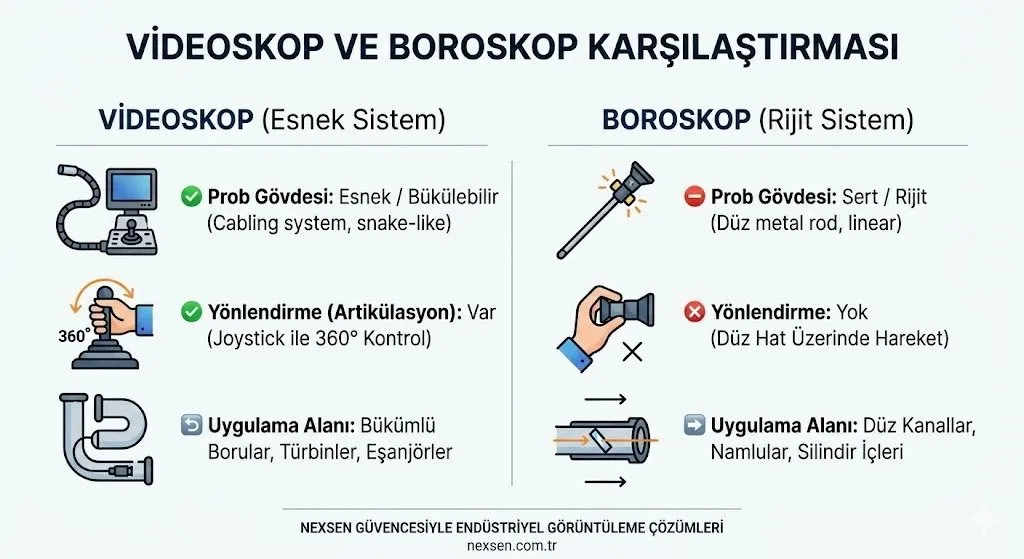
Borescope (Rigid / Solid Shaft Technology): Traditional rigid borescopes feature a non-bending, solid shaft typically made of high-quality stainless steel. They house a series of glass optical lenses lined up inside the shaft (Rod Lens Technology) to transmit images. The shaft structure is completely linear and lacks flexibility. Semi-rigid models are manufactured from anodized alloys that can be slightly shaped but retain the given form.
-
Videoscope (Flexible and Multi-Directional Articulation): Videoscopes offer a completely flexible probe structure that easily adapts to curved and complex paths. The outer layer of the probe is covered with Tungsten Braiding to provide maximum resistance against abrasion and mechanical wear. The primary operational advantage is the articulation capability; the camera tip can be steered 2-way or continuously 360-degree 4-way via a mechanical or servo-motor-driven joystick.
2. Optical Performance vs. Digital Image Sensors
-
Borescope: Light and images are transmitted directly through the physical alignment of glass lenses and fiber optic light bundles. As a result, rigid borescopes deliver flawless optical clarity, zero latency, unmatched contrast, and 100% lifelike color accuracy that no digital sensor can match. If the inspection path is short and completely straight, the optical performance of a borescope surpasses all digital systems.
-
Videoscope: Images are captured by micro-scale CMOS or CCD digital camera sensors placed at the very tip of the probe. The image data is transmitted through electronic signal cables inside the probe to the main control unit’s display screen. Modern industrial videoscopes reach HD (720p) and Full HD (1080p) resolutions, offering advanced image processing features such as digital zoom, brightness adjustment, and digital filtering.
3. Summary Comparison Schema (Videoscope vs. Borescope)
4. International NDT Standards & Compliance
While both product lines serve international guidelines in Visual Testing (VT), specific geometric inspection and reporting requirements dictated by auditing bodies (TÜV, SGS, Lloyd’s, etc.) determine the ideal equipment choice:
-
ASME Section V – Article 9 Compliance: Internal inspections of pressure vessels, boiler tubes, and nuclear components often require millimetric sizing of discontinuities (crack width, corrosion depth, lack of fusion area). Digital videoscope systems embedded with advanced Stereo, Shadow, or Comparison Measurement software fully satisfy these legal reporting conditions by calculating defects directly on-screen.
-
EN 13018 / ISO 13018 & ISO 17637 Compliance: Remote Visual Inspection (RVI) of fusion-welded joints requires high resolution and reflection control. Rigid borescopes display microporosity and color changes in their purest form without digital pixelation, thanks to the rod lens configuration. However, on highly reflective metallic surfaces like polished stainless steel, the software-driven anti-glare and High Dynamic Range (HDR) features of modern videoscopes provide a clearer view that conforms better to these standards.
-
Aerospace Standards (AWS D1.1): Asymmetric military and civil aviation procedures for jet engines and helicopter turbine blades (blisk and combustion chamber inspection) require tracking tip temperatures. Advanced industrial videoscopes equipped with integrated tip temperature sensors and warning indicators legally safeguard the inspection process.
5. Environmental Resistance, IP Ratings, and ATEX Requirements
-
Fluid and Chemical Resistance: Both equipment groups provided by Nexsen offer IP67 / IP68 ingress protection on the probes against water, industrial oils, hydraulic fluids, jet fuel (JP-8), gasoline, and diesel derivatives.
-
Temperature and Ex-Proof Limits: Rigid borescopes exhibit higher thermal resistance in extreme heat (such as furnace interiors or recently shut down engine blocks) due to their purely mechanical/optical build. However, when inspecting explosive and flammable environments (fuel tanks, gas pipelines, refineries), using specialized ATEX (Ex-Proof) certified systems, such as the iRis DVR X ATEX Videoscope, is a strict legal requirement to prevent spark hazards.
????️ Request Engineering Support and a Live Demo: Contact the Nexsen technical team for free consultancy and live product demos to determine the ideal configuration for your internal geometries, technical specifications, and corporate budget. Explore our comprehensive inventory on our dedicated product pages or contact us directly for competitive pricing.What is Visual Inspection?You can access our videoscope–borescope devices from the link below:
Visual Inspection EquipmentFor CMM applications for pipes (barrels), you can review the product below:
LaserNDT