
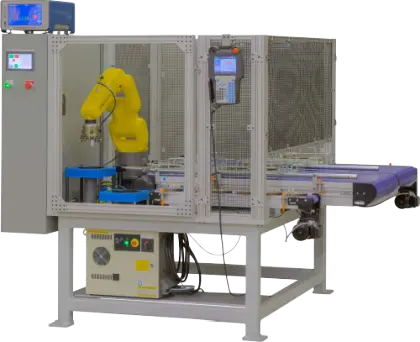
In series production, a part’s hardness, heat treat quality or a small surface crack comes back as a broken axle in the field, a warranty claim or a recall. The classic approach cuts a few samples from each batch and measures hardness, but a good sample does not mean the whole batch is good. An induction coil fault, a furnace temperature drift or a mixed-up material lot can affect hundreds of parts between samples.
Eddy current sorting and crack testing removes this risk by checking 100% of parts at production speed, without touching them. This guide explains how the method works, which defects it separates, real part examples and the steps to take before investing.
What is eddy current sorting?
Eddy current sorting measures the eddy currents induced when a conductive part passes through a coil or probe. The part’s electrical conductivity and magnetic permeability depend on microstructure, hardness, heat treat condition, alloy and geometry. A part that missed heat treatment, stayed soft, has a different case depth or is made of the wrong material leaves a different signature in the coil than a good part.
Modern sorting instruments measure this signature at several frequencies at once. Low frequencies look deep into the part, high frequencies near the surface. The Criterion ST-11, for example, tests at up to 8 frequencies between 5 Hz and 4 MHz and separates several reject conditions in one test. It is taught with good production parts only; any part falling outside the zone formed by good parts is rejected.
Defects that sorting separates
- Heat treat verification: hardened / unhardened parts, missing or excessive heat treatment, soft ends
- Hardness checks: parts outside the hardness range
- Case depth and case pattern: deviations in hardening depth and pattern
- Material mix: parts of a different alloy or grade mixed in
- Thread and feature checks: thread presence and correctness, spline quality, ID and OD features
- Assembly validation: missing, wrong or soft components (for example a soft ball in a bearing)
Eddy current crack testing
Crack testing looks for surface or near-surface discontinuities rather than material structure. A crack interrupts the eddy current path and creates a sudden change in the probe signal. Rotating probes, pencil probes and part-specific coils detect fatigue, grinding and heat treat cracks in forged, cast and machined parts at production speed. Continuous stock such as bar, tube and wire is tested by passing it through an encircling coil.
The Criterion CR-11 works between 10 kHz and 4 MHz and its high signal-to-noise ratio catches the smallest flaws. Ellipse, square, hexagon or auto alarm shapes prevent good parts from being rejected, and a strip chart view helps review test data and optimise flaw response.
Sorting or crack testing?
| Criterion | Eddy current sorting (ST-11) | Eddy current crack testing (CR-11) |
|---|---|---|
| Purpose | Heat treat, hardness, material structure and mix | Cracks and surface flaws |
| Frequency | 5 Hz – 4 MHz, up to 8 frequencies | 10 kHz – 4 MHz, single frequency |
| Probe type | Encircling coil or part-specific probe | Rotating probe, pencil probe, custom coil |
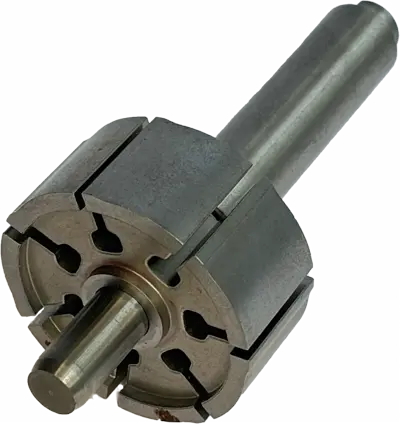
| Typical parts | Axles, CVJ shafts, gears, bearings, brackets, clips | Pump rotors, gears, shafts, ball studs, bar, tube, wire |
| Line output | Pass / fail and reject reason | Pass / fail, flaw signal |
Many production lines run both checks at one station: heat treat and material are verified first, then critical zones are scanned for cracks.
Application examples from real parts
Eddy current sorting and crack testing are widely used on automotive and power transmission parts:
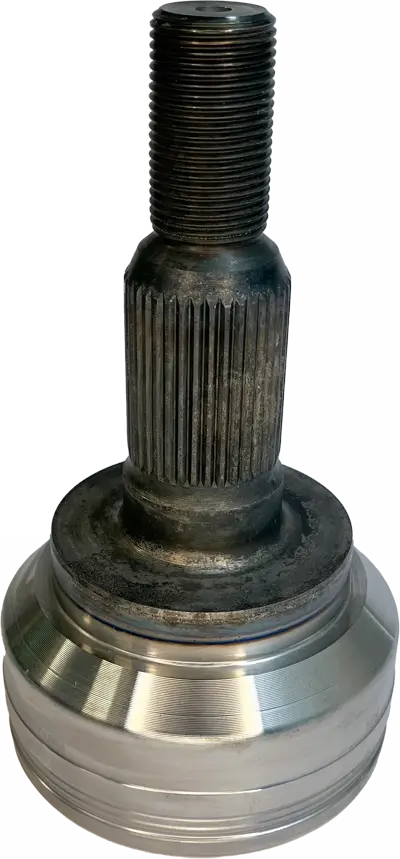
- CV joint shaft: heat treat verification, crack test, thread anneal and spline quality checks
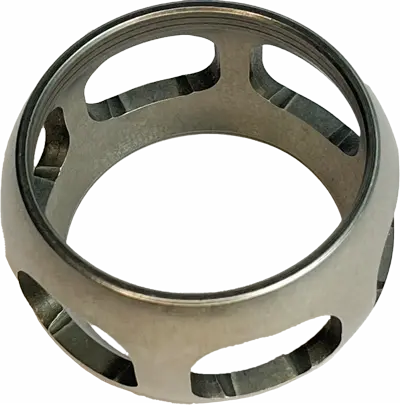
- Bearing cage and bearing hub: crack test and heat treat verification
- Ball stud: hardness, crack and thread tests
- Pinion gears and sprockets: heat treat and crack detection
- Pump rotor and pump shaft: crack detection and hardness validation
- Seat adjustment brackets, spring clips, latch parts: heat treat and hardness checks
- Differential case, large nuts, cam cover: thread validation
- Airbag inflator: burst disc check
Part-specific probe and coil design
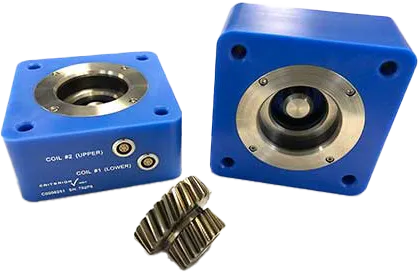
Reliable results start with the right probe. Multi-zone coils for gear heat treat verification, encircling coils for shaft hardness, hardness and case pattern probes for bearing outer rings, and pencil and rotating probes for bores are designed around the part geometry, so different zones of the same part are evaluated separately.
Automated stations and line integration
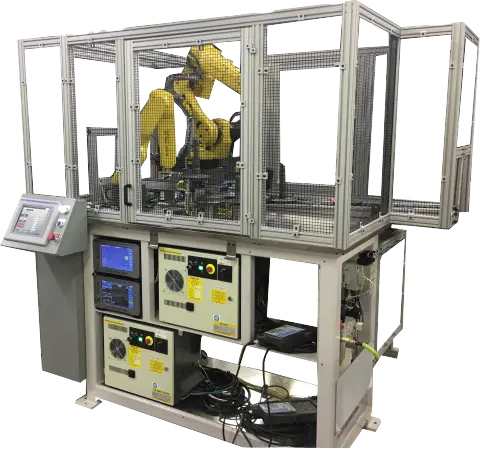
Eddy current instruments connect to the PLC through TCP/IP and discrete industrial I/O, and fully automated stations are built with robots, conveyors and reject gates. The robot places the part in the coil, the instrument decides in seconds, bad parts are diverted and all results are recorded. Dual-robot, multi-location stations are common for transmission shafts and gears, axles and splines.
Five steps before you invest
- Define the risk: which defect (heat treat, hardness, material mix, crack) would cost the most if it reached a customer?
- Feasibility study: test with good and known-bad parts whether the method separates the defect reliably. Criterion NDT offers feasibility studies with your own production parts; NEXSEN runs this process from Turkey.
- Probe and coil selection: choose standard or custom probes for the part geometry and the zones to be checked.
- Line integration: plan cycle time, part feeding, rejection and PLC communication.
- Validation and training: after commissioning, keep the system reliable with periodic reference part checks and operator training.
Eddy current sorting does not fully replace destructive hardness and metallography tests; they remain the reference and periodic verification. The difference is that inspection moves from samples to every part.
Frequently asked questions
Does eddy current sorting measure hardness?
Eddy current does not give an HRC value directly; it compares the part’s electromagnetic signature with known good and bad parts. Because hardness, heat treatment and microstructure change this signature, parts with wrong hardness or missing heat treatment are separated reliably.
Which materials can be tested?
Conductive materials such as steel, cast iron, aluminium, copper and titanium. The most common application is heat-treated steel automotive parts.
Does it work at line speed?
Yes. A test takes seconds and the result goes to the PLC immediately, so 100% of parts are checked at production speed.
NEXSEN and Criterion NDT
NEXSEN supplies Criterion NDT products in Turkey. For the ST-11 eddy current sorting instrument and the CR-11 eddy current crack tester we provide feasibility, probe selection, line integration, training and service. See also Eddy Current Testing and Online / Inline Systems. For a free feasibility discussion with your part, contact us.